
BLOG
How to Eliminate Daily Watering and Grow a Healthier Garden

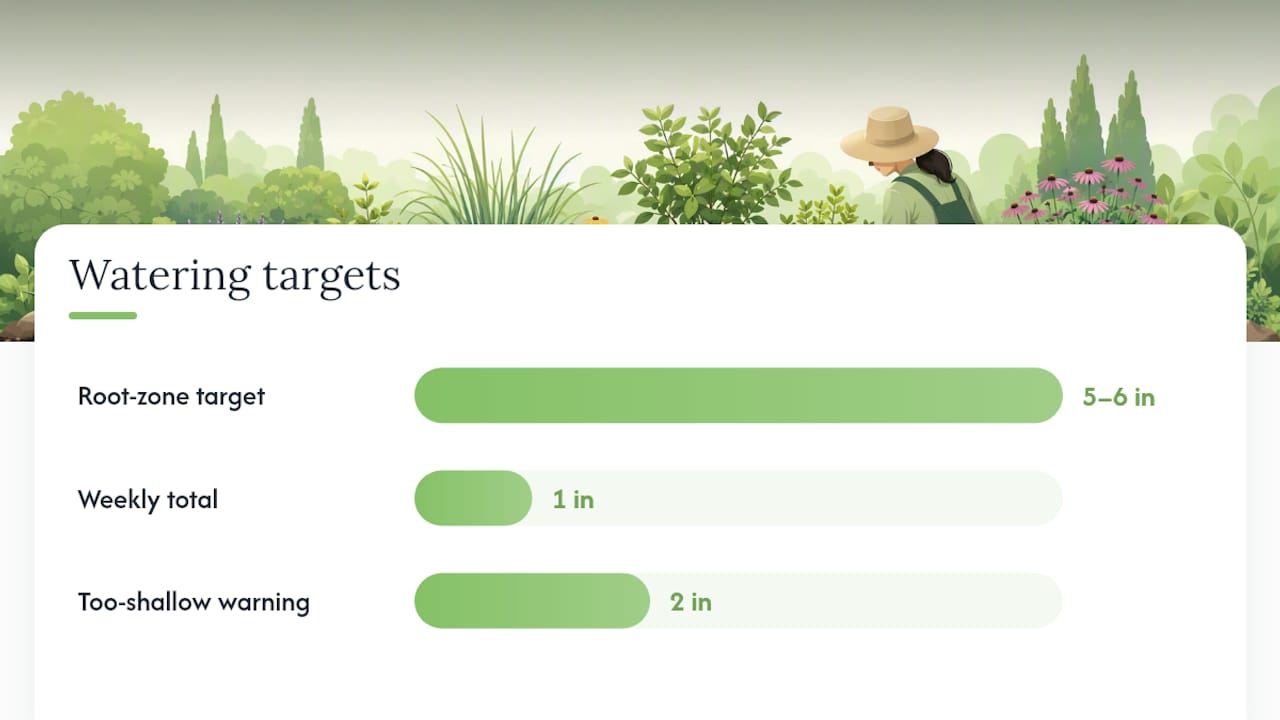
The fastest way to eliminate daily watering is to stop sprinkling shallowly and start watering deeply, on a measured schedule. Wet the soil to about 5–6 inches (15 cm) so roots stretch down to find it, and aim for roughly 1 inch of total water per week, rain included. You don’t need to guess at this. Run the tuna-can test to see how much water your sprinkler actually delivers, poke a screwdriver into the soil to confirm you’ve hit that 5–6 inch mark, and set your watering window for early morning.
From there, a handful of low-effort systems do the heavy lifting for you:
- Mulch 2–3 inches deep to slow evaporation and keep roots cooler.
- Drip lines or soaker hoses to put water at the root zone instead of the air.
- Cycle-and-soak watering to stop runoff on clay soil or slopes.
- Self-watering containers, like FarmDaddy’s reservoir system, to handle pots and small beds without a daily check.
Get these four pieces in place and daily watering becomes a chore of the past, not a permanent fixture of your summer.
Key Takeaways
Eliminating daily watering comes down to wetting soil to 5–6 inches deep and hitting roughly 1 inch of total water weekly, using mulch, drip systems, cycle-and-soak, or a self-watering reservoir to make it automatic.
| Point | Details |
|---|---|
| Water deep, not daily | Soak soil to 5–6 inches per session instead of a shallow daily sprinkle. |
| Hit the weekly target | Aim for about 1 inch of total water per week, rain included. |
| Water in the morning | Early morning (5–10 a.m.) cuts evaporation and disease risk versus evening watering. |
| Test before you assume | Use the tuna-can test for output and the screwdriver test for depth. |
| Solve containers with reservoirs | Farmdaddy’s self-watering planters remove the daily container check with independent reservoirs for each plant. |
Table of Contents
- Why Eliminating Daily Watering Actually Helps Your Plants
- How to Water Deeply: Targets and Simple Tests
- When Should You Water, and How Does Soil Type Change the Answer?
- Practical Systems That Remove Daily Watering From Your Routine
- How Do You Know When Your Garden Actually Needs Water?
- Sample Watering Schedules by Soil and Garden Type
- Why Self-Watering Containers Solve the Last Daily Chore
- The Most Important Watering Change to Make Right Now
- Let Farmdaddy Handle the Watering You’d Rather Not Think About
- Frequently Asked Questions
- Sources
Why Eliminating Daily Watering Actually Helps Your Plants
Daily light watering feels productive, but it works against your garden in three specific ways, and once you see them, you won’t want to go back to a hose-every-evening routine.
Shallow, frequent watering trains roots to stay near the surface. If water always shows up in the top inch or two of soil, roots have no reason to dig deeper. Those shallow roots dry out fast during a heat wave and leave your plants far more vulnerable to drought stress than roots that have grown down 5 to 6 inches, where soil holds moisture longer. Deep, infrequent watering does the opposite. It forces roots to chase water downward, and Texas A&M’s Earth-Kind program notes that deeper root systems built this way handle dry spells far better than shallow ones.
Then there’s the water you’re simply losing to the air. Light watering during the heat of the day evaporates before it ever reaches the roots.
Watering in the early morning, roughly between 5 and 10 a.m., cuts down evaporation and disease pressure compared to daytime or evening sessions. Spacing watering out to once every three days, instead of daily, can reduce evaporative water loss by about 10% compared to watering every single day.
That’s water you paid for through your hose or irrigation system, gone into the atmosphere instead of into your tomatoes.
The third issue is disease. Watering in the evening or overnight leaves leaves wet for hours, sometimes all night, and that damp environment is exactly what fungal and bacterial pathogens need to take hold. Powdery mildew, blight, and root rot all thrive in gardens where foliage stays wet after dark. Morning watering gives plants the whole day to dry off in the sun, which cuts that risk dramatically. If you’ve noticed spotty leaves or mildew creeping across your squash plants every August, your watering schedule might be more responsible than the weather.
How to Water Deeply: Targets and Simple Tests
You can’t manage what you don’t measure, and this is where most home gardeners go wrong. They water “for a while” instead of watering to a target. Two numbers matter here, and both come straight from university extension research.
- Depth target: 5–6 inches. This is roughly the active root zone for most lawns, vegetables, and perennials, and it’s the depth Colorado State University Extension recommends soaking to during each watering session.
- Weekly total: about 1 inch. This includes rainfall, so a rainy week might need no supplemental watering at all, while a dry, hot week calls for the full inch delivered in one or two sessions rather than seven small ones.
Getting your irrigation to actually hit these numbers takes about ten minutes of setup, and you only have to do it once per sprinkler or hose setup.
The tuna-can test. Place a few empty tuna cans (or any straight-sided container) around your watering zone, run your sprinkler for 15 minutes, then measure the water depth in each can with a ruler. Average the readings, then do the math: if you collected a quarter inch in 15 minutes, you need 60 minutes of total runtime to hit 1 inch for the week.
The screwdriver test. After watering, push a long screwdriver or a soil probe straight down into the ground. It should slide through moist soil with light pressure and meet resistance once it hits dry soil below. If it stops at 2 inches, you’re not watering deeply enough yet, no matter how long your sprinkler ran.
| Test | What it tells you | Tool needed |
|---|---|---|
| Tuna-can test | How much water your sprinkler delivers per hour | Empty can, ruler, timer |
| Screwdriver/probe test | How deep the water actually penetrated | Screwdriver or soil probe |
| Footprint test (lawns) | Whether turf needs water at all | None, just your foot |
Run these two tests once, and you’ll know exactly how many minutes your specific sprinkler, drip line, or hose needs to run to eliminate the guesswork for the rest of the season.
When Should You Water, and How Does Soil Type Change the Answer?
Timing and soil type are the two variables most gardeners ignore, and they’re exactly why a fixed “water every day at 6 p.m.” routine fails.
The best window to water is early morning, roughly 5 to 10 a.m. Temperatures are cooler, wind is usually calmer, and plants have the full day ahead to dry off before nightfall. Evening watering feels convenient after work, but it sets up exactly the damp overnight conditions that invite fungal disease.
Soil type changes how often you need to water and whether you need to break sessions up at all:
- Clay soil absorbs water slowly and holds it for a long time. One deep session per week is often enough, but you’ll need to apply water in short bursts with breaks in between, known as cycle-and-soak, or it will run right off the surface instead of soaking in.
- Sandy soil drains fast and holds very little moisture, so it typically needs two to three sessions per week even though each one uses less water per visit.
- Loam, the middle ground most gardeners have, usually needs one to two deep sessions weekly and tolerates a straightforward soak without much runoff risk.
Weather throws a wrench into any fixed schedule. During a heat spike, say a stretch of 100°F days, evaporation and plant water use both climb, and you may need to add an extra session that week. On the flip side, an inch of rainfall on Tuesday means you can skip Thursday’s watering entirely. Track rainfall with a simple rain gauge so you’re adjusting based on real numbers, not guesswork.
Pro Tip: Keep a cheap rain gauge stuck in the ground near your garden. Glancing at it takes five seconds and saves you from watering a garden that already got what it needed from the sky.
Practical Systems That Remove Daily Watering From Your Routine
Knowing the targets is half the battle. The other half is setting up your garden so you’re not the one standing there with a hose every evening. Five approaches do most of the work.
Mulch first, always. A 2 to 3 inch layer of shredded bark, straw, or compost across your beds slows evaporation, keeps soil temperature more stable, and suppresses the weeds that compete with your plants for water. It’s the cheapest change on this list and often the one that buys you the most breathing room between watering sessions.
Drip irrigation or soaker hoses deliver water directly to the soil at the root zone instead of spraying it into the air where wind and sun steal a chunk of it. Properly managed drip systems can cut water loss by up to 60% or more compared to overhead sprinklers, because almost nothing evaporates before it reaches the roots.
Cycle-and-soak programming solves the runoff problem on clay soil or sloped beds. Instead of running your system for 60 straight minutes, split it into two or three shorter cycles of 20 minutes each, with 30 to 60 minute breaks between them so water has time to soak in before the next cycle starts. This technique preserves your full weekly total; it just delivers it in a way the soil can actually absorb.
Smart controllers that adjust based on weather or evapotranspiration (ET) data outperform simple timers, because a timer runs on the same schedule whether it rained yesterday or not. The EPA WaterSense program notes that weather-based controllers can save meaningfully more water than fixed-schedule timers when they’re properly configured for your climate and soil. The tradeoff is setup time. Sensor-based systems need calibration for your specific soil and site, similar to how rain-sensor technology automatically halts other outdoor systems once it detects moisture, rather than running on blind schedule.
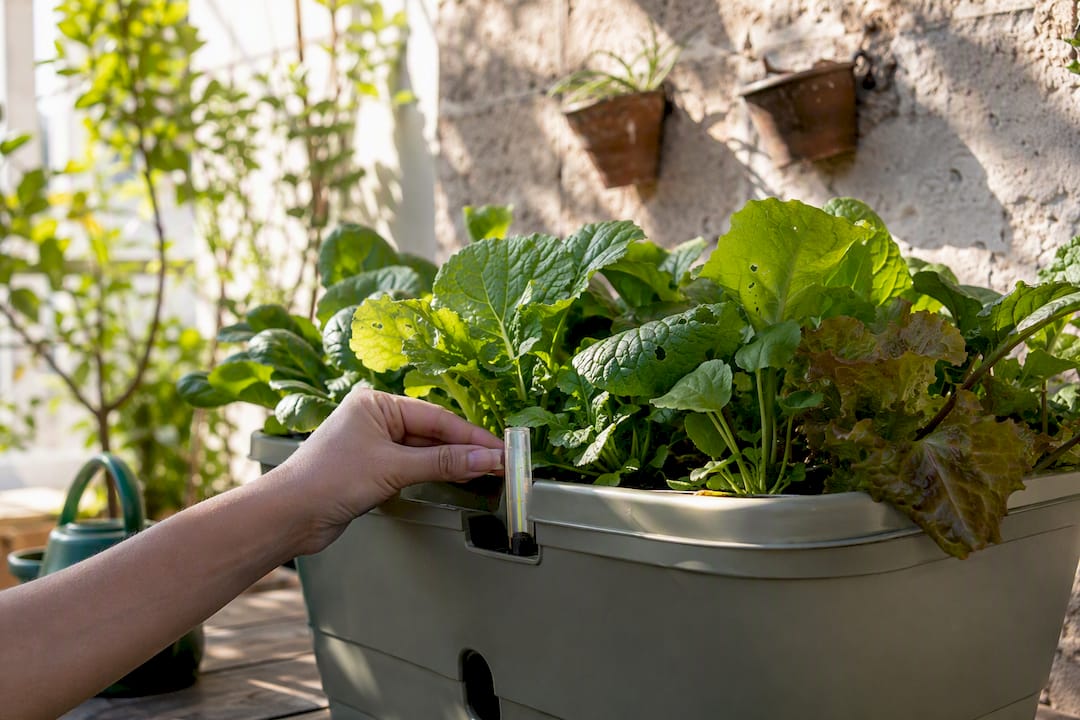
Self-watering containers solve a completely different problem: pots and small raised beds that dry out fast because they hold so little soil volume. Without some kind of reservoir, containers often need daily attention just to keep plants alive through a hot afternoon. A self-watering system stores water in a base reservoir and lets each connected planter pull up moisture as its soil actually needs it, which removes the daily check entirely for container gardens, patio herbs, and small vegetable beds.
Pro Tip: Combine mulch with drip irrigation for the biggest single jump in water efficiency. The drip line delivers water precisely, and the mulch on top stops the sun from pulling it right back out.
How Do You Know When Your Garden Actually Needs Water?
Schedules are a starting point, not gospel. The most reliable gardeners check the soil and the plant itself before turning anything on.
- Dig or probe 2 to 3 inches down before watering. If the soil feels moist at that depth, skip the session. Dry, crumbly soil at 2 inches means it’s time to water. This single habit prevents more overwatering than any app or timer.
- Watch how a plant wilts. Drooping leaves in the early morning almost always mean the plant needs water. But midday wilting in blazing heat can be a protective response where the plant temporarily reduces water loss through its leaves, even though the root zone still has plenty of moisture. Check the soil before you react to a wilted plant at 2 p.m.
- Use the footprint test on lawns. Walk across the grass, and if your footprints spring back up within a few minutes, the lawn has enough water. If they stay pressed in, it’s time to water.
- Skip watering after a real rain. A measured half inch or more of rainfall counts directly against your weekly 1-inch target. Check your rain gauge before you reach for the hose out of habit.
These four checks take less time than turning on a sprinkler and prevent the two most common mistakes: watering a plant that’s protecting itself from heat, and skipping water a genuinely dry root zone needs.
Sample Watering Schedules by Soil and Garden Type
Numbers make this easier to act on immediately, so here’s how the targets above translate into real sessions per week for different setups.
| Garden type | Sessions per week | Notes |
|---|---|---|
| Clay lawn | 1 deep session | Use cycle-and-soak (2–3 short cycles) to prevent runoff |
| Sandy lawn | 2–3 sessions | Lower volume per session since sandy soil drains fast |
| Vegetable bed (loam) | 1–2 sessions | Adjust up during fruiting stages or heat spikes |
| Containers without reservoir | Daily | Small soil volume dries out fast without a self-watering system |
| New seedlings/transplants | Light watering every 1–2 days for first 2 weeks | Roots aren’t established yet; switch to deep watering once rooted |
To turn these into actual minutes, go back to your tuna-can results. If your test showed a quarter inch delivered in 15 minutes, then:
- Calculate total runtime needed for 1 inch: 60 minutes per week.
- Divide that across your session count. A clay lawn getting one session needs the full 60 minutes, split into cycles. A sandy lawn getting three sessions needs about 20 minutes each.
- Recheck with the screwdriver test after the first week and adjust up or down until you’re consistently hitting 5–6 inches deep.
New transplants are the one exception to the “go deep immediately” rule. Their root systems haven’t developed yet, so light, more frequent watering for the first one to two weeks helps them establish before you transition to the deep, infrequent schedule that mature plants thrive on.
Why Self-Watering Containers Solve the Last Daily Chore
Every method above works well for garden beds and lawns, but containers are a different animal. Their limited soil volume just can’t hold a week’s worth of water, which is why pots so often become the one part of the yard still demanding daily attention even after you’ve fixed everything else.
This is exactly the gap Farmdaddy’s self-watering containers were designed to close. Each planter connects to a shared reservoir but draws water independently, so a thirsty tomato plant doesn’t leave your basil sitting in soggy soil. The patented reservoir design keeps root-zone moisture steady without you checking pots morning and night.
A few places this matters most:
- Vacations. A reservoir-fed container can keep plants hydrated for days without anyone home to water them.
- Mixed plantings. Herbs, vegetables, and flowers all have different water needs, and independent reservoirs mean each container gets exactly what its plant requires.
- Busy schedules. If you travel for work or simply don’t want gardening to feel like a second job, a self-watering setup removes the single daily task most likely to get skipped.
Gardeners who switch typically notice healthier, more consistent growth within the first few weeks, since plants stop cycling between too-dry and too-wet, and start getting steady moisture instead.
The Most Important Watering Change to Make Right Now
Read enough gardening advice and you’ll notice most of it treats watering frequency and watering depth as the same conversation. They’re not, and that’s where a lot of well-meaning advice leads gardeners astray. A schedule that says “water three times a week” means nothing if each session only wets the top inch of soil. The depth is the whole game. Frequency is just the delivery mechanism.
Conventional wisdom overweights convenience: set a timer, water every evening, don’t think about it. That habit is precisely what keeps root systems shallow and water bills high. The research points somewhere more useful. Measure your output once with a tuna can, confirm depth once with a screwdriver, and you’ve replaced years of guesswork with a system that runs itself.
If you’re starting today, prioritize the depth target over everything else. Frequency, timing, and soil adjustments all matter, but they’re refinements. Get the 5–6 inch depth right first, and the rest of this playbook becomes fine-tuning rather than a fresh habit to build from scratch.
Let Farmdaddy Handle the Watering You’d Rather Not Think About
Mulch, drip lines, and cycle-and-soak all work well for garden beds, but containers are where daily watering hangs on the longest, especially if you’re growing on a patio, balcony, or anywhere soil volume is limited. Farmdaddy built its self-watering system specifically for that gap. Each planter draws from a shared reservoir independently, so your tomatoes and your basil get exactly the moisture each one needs, without you refilling anything daily or guessing which pot dried out first.
If you’re growing a mix of vegetables, herbs, and flowers, or you just want to leave for a weekend without arranging plant sitters, the self-watering container system is worth a look. For patio or balcony gardeners who want a complete setup out of the box, the two-planter system gives you two independent reservoirs ready to plant the same day it arrives. Browse the full lineup at Farmdaddy and pick the setup that matches how much space, and how many plants, you’re working with.
Frequently Asked Questions
Can I really eliminate daily watering for my vegetable garden? Yes. Most established vegetable beds in loam soil only need one to two deep watering sessions per week once you switch from shallow daily watering to deep sessions that reach 5–6 inches.
How do I know if my sprinkler is delivering enough water? Run the tuna-can test: place a few open cans in your watering zone, run the sprinkler for 15 minutes, and measure how much water collected. That tells you exactly how many minutes you need to hit your weekly 1-inch target.
Do containers ever stop needing daily watering? Not without a reservoir. Standard pots typically dry out fast because they hold so little soil, but a self-watering container with a built-in reservoir can go days without attention since the plant draws water as needed.
What if it rains during my watering week? Subtract it from your 1-inch weekly target. A half inch of rain means you only need another half inch from your hose or irrigation system that week.
Is evening watering really worse than morning watering? Yes, mainly because of disease risk. Wet leaves overnight create ideal conditions for fungal and bacterial problems, while morning watering gives plants all day to dry before nightfall.
Sources
- Lawn care basics | Colorado State University Extension
- Is it time to water the lawn? | University of Missouri Extension
- Prevent lawn problems | Oregon State University
- Efficient use of water in the garden and landscape | Texas A&M (Earth-Kind)
Recommended
- Water Saving Gardening Ideas Using Self Watering Garden System & Conta – FarmDaddy®
- Best Self-Watering Planters: Top Picks for Low-Maintenance Gardeners – FarmDaddy®
- Self-Watering Planter System: Your Easy-Care Garden Guide – FarmDaddy®
- Low Maintenance Vegetable Garden for Busy Beginners – FarmDaddy®

