
BLOG
Container Depth for Vegetables: The Complete Grower's Chart

Match container depth to the plant’s root habit: 4–6 inches for shallow greens, 8–12 inches for medium-rooted vegetables, and 12–18 inches or more for deep-rooted crops. Purdue Extension groups vegetables into these three bands and notes that depth often matters more than width for healthy root development. The University of Maryland Extension translates those bands into volume: 1–3 gallons (4–6" depth) for leafy greens, 4–6 gallons (8–12") for medium crops, and 8–10 gallons (12–16") for larger vegetables like tomatoes, peppers, and cucumbers. Two quick exceptions worth knowing up front: very small herbs like chives or thyme thrive in just 4 inches, and micro-dwarf tomato varieties can manage in 5 gallons where a standard indeterminate would fail.
- Shallow (4–6", 1–3 gal): Lettuce, spinach, radishes, herbs, green onions
- Medium (8–12", 4–6 gal): Peppers, eggplant, beans, beets, chard, cucumbers
- Deep (12–18"+, 8–10+ gal): Tomatoes, carrots, squash, potatoes, sweet potatoes
Farmdaddy self-watering systems change the watering cadence for any of these groups, but the soil-depth rules above still apply regardless of how water is delivered.
Key Takeaways
Matching container depth to your vegetable’s root habit is the single most reliable way to improve yields, reduce watering stress, and keep plants healthy through the whole growing season.
| Point | Details |
|---|---|
| Measure usable soil depth | Subtract reservoir height or false bottom from total depth; that number is what your plant actually gets. |
| Follow the depth chart by group | Use 4–6" for leafy greens, 8–12" for medium crops, and 12–18"+ for tomatoes, root crops, and potatoes. |
| When unsure, go larger | A bigger pot buffers moisture and nutrients; the penalty for going too large is minimal, but too small costs yield. |
| Account for material and color | Dark, porous pots dry faster; light-colored or self-watering containers reduce watering frequency significantly. |
| Farmdaddy self-watering planters | Sized for specific crop groups, they maintain steady moisture and reduce the risk of the dry-wet cycles that stress roots. |
Table of Contents
- What is the right container depth for vegetables?
- Why container depth matters more than you might think
- How to measure usable container depth and pick the right pot
- How potting mix, drainage, and depth affect your watering schedule
- Adapting depth guidance for hanging baskets, window boxes, grow bags, and stock tanks
- Growing potatoes and other deep-rooted crops in containers
- How self-watering containers change depth needs and watering frequency
- Practical planting tips tied to container depth
- What I have learned watching container depth decisions play out
- Farmdaddy self-watering planters make depth decisions easier
- Sources
What is the right container depth for vegetables?
The table below covers the most commonly grown vegetables, organized by root depth. Depth is measured as usable soil depth (from drainage holes to soil surface). Volume figures come from UC Master Gardener guidance and Colorado State Extension.
| Vegetable | Min. Depth | Min. Volume | Pot Diameter | Notes |
|---|---|---|---|---|
| Lettuce | 4–6" | 1–2 gal | 6–8" | Shallow roots; ideal for window boxes |
| Spinach | 4–6" | 1–2 gal | 6–8" | Bolts fast in heat; use deeper pot in warm climates |
| Radish | 4–6" | 1 gal | 6" | Short-root varieties only at 4"; standard need 6" |
| Herbs (basil, thyme, chives) | 4–6" | 1–2 gal | 6–8" | Chives and thyme manage at 4"; basil prefers 6" |
| Strawberries | 6–8" | 1–2 gal | 8" | Hanging baskets work well |
| Green onions | 4–6" | 1 gal | 6" | Dense planting fine; thin to 2" apart |
| Beans (bush) | 8–10" | 2–3 gal | 8–10" | Pole beans need trellis and 10–12" depth |
| Beets | 8–10" | 2–3 gal | 8–10" | Cylindrical varieties need 10" minimum |
| Chard / Kale | 8–10" | 2–3 gal | 10" | Increase volume in hot climates |
| Peppers | 10–12" | 4–5 gal | 10–12" | Deeper pots reduce blossom end rot risk |
| Eggplant | 10–12" | 4–5 gal | 10–12" | One plant per 5-gallon container |
| Cucumbers | 10–12" | 4–5 gal | 10–12" | Trellis required; Colorado State lists 8" minimum |
| Broccoli / Cabbage | 10–12" | 4–5 gal | 12" | One head per container; needs stable, heavy pot |
| Carrots | 12–14" | 3–5 gal | 10–12" | Short-root varieties (Chantenay, Danvers) at 12" |
| Tomatoes (determinate) | 12–15" | 5–10 gal | 12–14" | Bury stem deeply to encourage root mass |
| Tomatoes (indeterminate) | 18–24" | 15–25 gal | 16–20" | Stake or cage required; larger is always better |
| Squash / Zucchini | 16–18" | 10–15 gal | 14–18" | One plant per container; vertical training helps |
| Potatoes | 16–18"+ | 20–30 gal | 16–20"+ | Use hilling method; dedicated grow bags work well |
| Sweet potatoes | 16–18" | 15–20 gal | 16–18" | Long vines; plan for 3–4 months of growth |
A few quick notes:
- In climates where summer temperatures regularly exceed 90°F, move up one size category for any medium or deep crop.
- Determinate tomatoes like Patio, Bush Early Girl, or Celebrity do well at the lower end of their range. Indeterminate varieties like Sungold or Brandywine need the full 15–25 gallons.
- UC Master Gardeners of Santa Clara County confirm that leaf lettuces, radishes, green onions, and herbs thrive in 4–6 inches of soil, making them the best candidates for shallow window boxes or small balcony pots.
Why container depth matters more than you might think
Depth is the single most limiting factor in container vegetable gardening, and it affects four things at once: root space, water storage, nutrient availability, and soil temperature.
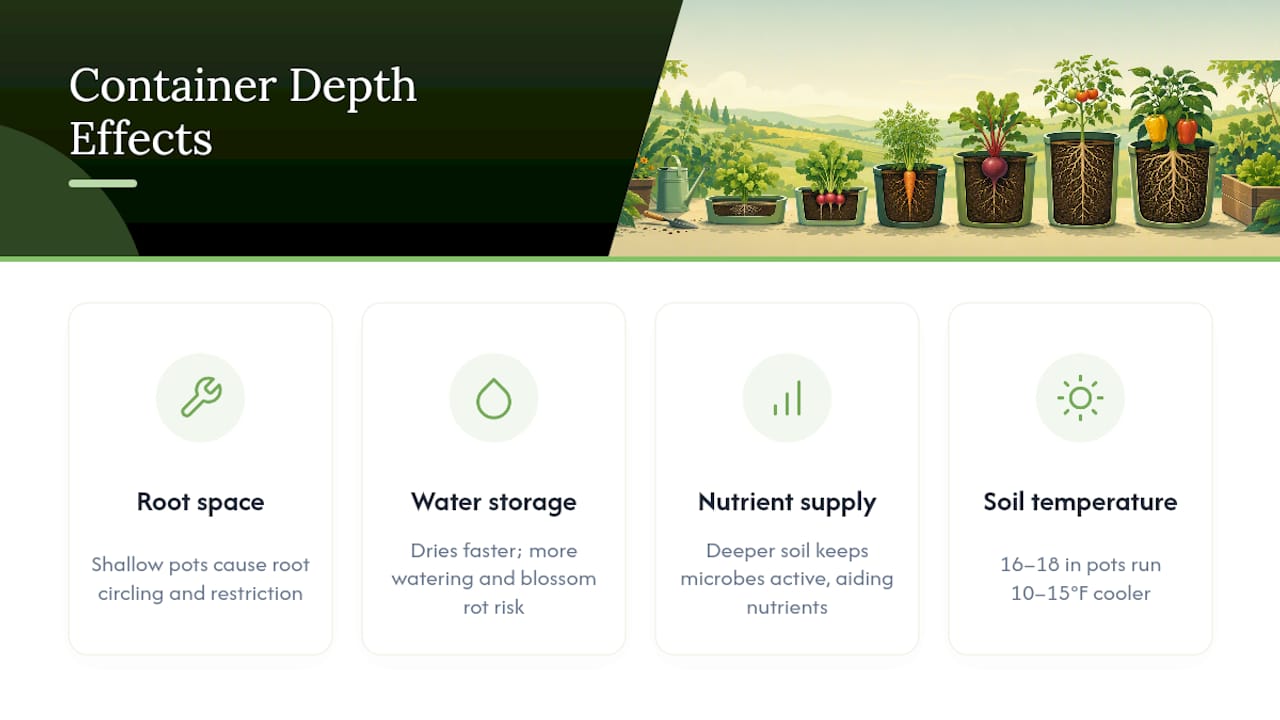
When roots hit the bottom of a pot, they circle and bind. That circling restricts water and nutrient uptake, stunts top growth, and in warm weather, accelerates heat stress because a small soil volume heats up fast. A shallow pot also dries out much faster than a deep one, which means more frequent watering and a higher risk of the moisture swings that cause blossom end rot in tomatoes and peppers.
Deeper soil does something less obvious too: it stays cooler. Root zones in a 16–18" pot can run 10–15°F cooler than those in a 6" pot on a hot patio, which keeps beneficial soil microbes active and oxygen levels higher. Healthy microbial activity breaks down organic matter into plant-available nutrients, so depth indirectly feeds your plants. Purdue Extension emphasizes this point directly, noting that depth often matters more than width for healthy root development.
Think of it this way: the top few inches of soil hold the feeder roots that absorb water and nutrients. Below that, the vertical root system anchors the plant and explores for moisture reserves. Cut that vertical space short and you cut the plant’s resilience.
Statistic callout: UC Master Gardener guidance recommends 16–18 inches or more for tomatoes, potatoes, and squash, specifically because deeper pots improve heat resilience and reduce the risk of root restriction during peak summer.
How to measure usable container depth and pick the right pot
The number printed on a pot’s label is usually the outer diameter, not the depth. Here is how to get the number that actually matters.
- Measure internal depth. Drop a ruler or stick straight down from the rim to the drainage holes at the bottom. That is your total internal depth.
- Subtract any false bottom or built-in reservoir. A self-watering planter with a 2" reservoir leaves you 10" of usable soil in a 12" pot. That is enough for peppers but not for indeterminate tomatoes.
- Check the diameter. A narrow 12" deep pot holds far less volume than a wide 12" deep pot. Volume (gallons) is the more reliable guide for large crops. A 12" depth in a 10" diameter pot gives roughly 5 gallons; the same depth in a 14" diameter pot gives closer to 8–9 gallons.
- Compare to the chart. Match your usable soil depth and volume to the vegetable you want to grow. If you are one size short, either choose a shallower-rooted variety or find a bigger container.
- Check for drainage holes. Iowa State University Extension is clear: any container must have drainage holes to be suitable. If yours does not, drill them before planting.
Pro Tip: When planting tomatoes, bury the stem up to the lowest set of leaves. Tomato stems develop roots along any buried section, which dramatically increases root mass and stability inside a container. UC Master Gardeners recommend this practice specifically for container growing, where root space is already limited.
How potting mix, drainage, and depth affect your watering schedule
Shallow pots and porous materials dry out fast. A 4–6" terracotta pot in full summer sun can need water twice a day. A 16" deep plastic or glazed ceramic pot in the same conditions might go 3–5 days between waterings. The difference is not just depth; it is also the container material.
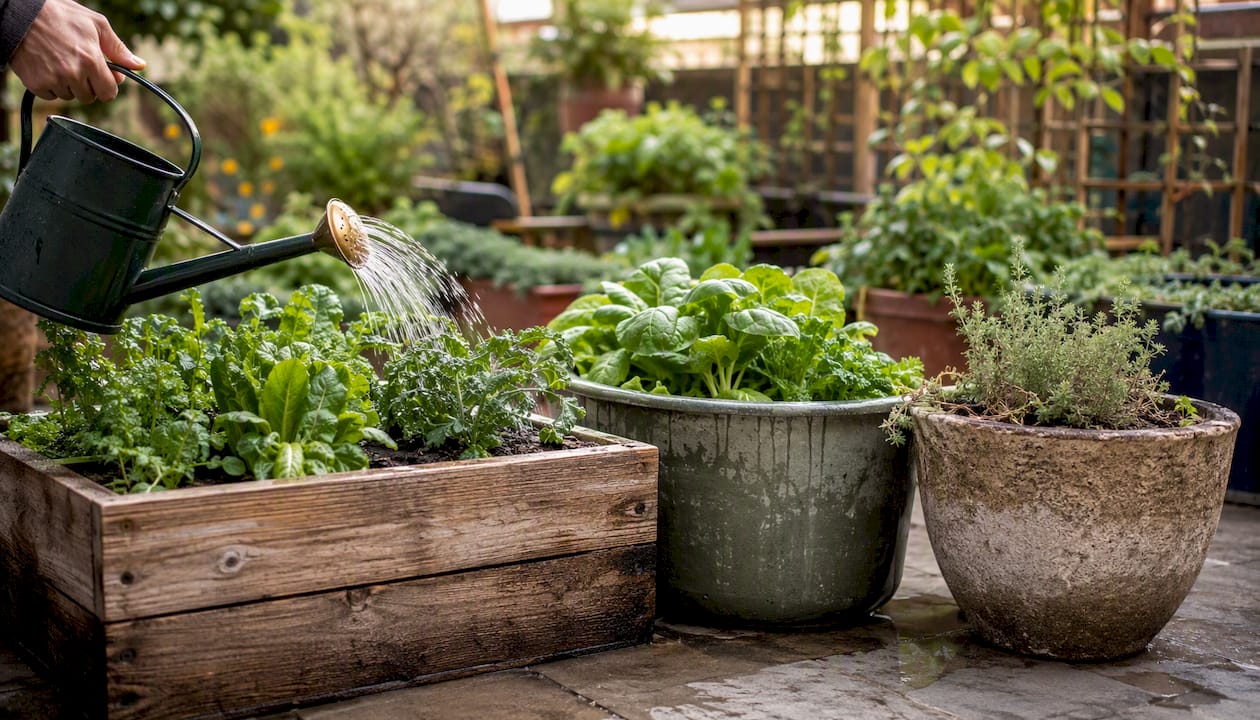
Iowa State University Extension notes that dark, porous containers dry faster than light-colored, non-porous ones, which directly increases watering frequency. A black plastic nursery pot in direct sun heats the root zone and accelerates evaporation from the soil surface.
General watering cadence by pot depth and season:
- 4–6" pot, summer: Water daily, sometimes twice daily in heat above 90°F
- 8–10" pot, summer: Every 1–2 days
- 12–14" pot, summer: Every 2–3 days
- 16–18"+ pot, summer: Every 3–5 days
- Any depth, self-watering reservoir: Refill reservoir every 5–10 days depending on crop and temperature
For potting mix, choose a lightweight, high-organic-matter blend designed for containers, not garden soil. Garden soil compacts, reduces drainage, and cuts oxygen to roots. Adding perlite (about 20–25% by volume) improves drainage and aeration. Mixing in coconut coir or vermiculite increases water retention, which is especially helpful in shallow pots where the soil volume is small.
Pro Tip: A 1–2" layer of straw or shredded leaf mulch on the soil surface cuts evaporation noticeably in shallow containers. This is one of the easiest ways to extend the time between waterings without changing the pot.
Adapting depth guidance for hanging baskets, window boxes, grow bags, and stock tanks
Not every gardener works with a standard round pot. Here is how to adapt the depth rules for the most common nonstandard containers.
- Hanging baskets (6–10" depth): Stick to shallow-rooted crops: trailing herbs, strawberries, leaf lettuce, and cherry tomatoes in micro-dwarf varieties only. Standard tomatoes will fail here. Line the basket with coconut coir to slow moisture loss, since hanging baskets dry out faster than any other container type.
- Window boxes (6–8" depth): Ideal for lettuce, spinach, herbs, radishes, and green onions. Avoid anything with roots deeper than 8". Choose a light-colored box to reduce heat absorption, and water daily in summer.
- Grow bags (fabric, 5–30 gallon): Fabric bags breathe, which air-prunes roots and prevents circling. They also dry faster than rigid containers. A 10-gallon grow bag gives roughly 10–12" of usable depth, suitable for peppers and determinate tomatoes. For potatoes, use a 20–30 gallon bag and fold the sides down at planting, then roll them up as you hill soil.
- Stock tanks (12–24" depth): These are among the best containers for deep-rooted crops. A standard 100-gallon galvanized stock tank gives 12–16" of depth and enough volume for multiple tomato plants, squash, or a potato patch. Drill drainage holes in the bottom and sides near the base. Paint or wrap in burlap to reduce heat absorption if the tank sits in full sun.
Iowa State University Extension recommends lining or insulating containers where depth is limited and heat is a concern. A simple fix: wrap a dark pot in light-colored fabric or bubble wrap to reduce root-zone temperature by several degrees.
When depth is genuinely inadequate, choose shallow-rooted varieties bred for containers (Patio tomatoes, Thumbelina carrots, Spacemaster cucumbers), grow vertically to reduce the footprint, or use intensive spacing to maximize yield from the soil volume you have.
Growing potatoes and other deep-rooted crops in containers
Potatoes need more volume than almost any other vegetable you will grow in a container. The University of Maryland Extension recommends a minimum of 30 gallons for potatoes, and that figure is not conservative. Tubers form along the buried stem above the seed potato, so the more vertical space you can give the plant, the more potatoes you harvest.
How to hill potatoes in a container:
- Start with a 20–30 gallon container or a dedicated potato grow bag, sides folded down to about 8" height.
- Add 4–6" of potting mix and plant seed potatoes 4" deep, eyes facing up.
- When foliage reaches 6–8" above the soil, add another 4" of mix, covering all but the top 2–3" of leaves.
- Repeat until the container is full or the bag sides are fully unrolled.
- Stop hilling when the plant flowers; tubers are forming and disturbing the soil now does more harm than good.
Alternative approaches when space is limited:
- Stacked tire or ring method: Add rings or tires as the plant grows, filling each with potting mix. Effective but requires planning for disassembly at harvest.
- Vertical potato planters: Fabric or plastic tower planters with side pockets allow harvesting from the sides without disturbing the whole plant. Best for smaller potato varieties.
- Stock tanks: A 100-gallon stock tank can support 4–6 seed potatoes and gives enough depth for full hilling without any workarounds.
Sweet potatoes follow similar volume rules but grow long vines rather than upright foliage. Plan for 15–20 gallons per plant and a trellis or fence to manage the vines over a 3–4 month growing season.
How self-watering containers change depth needs and watering frequency
Self-watering planters work by drawing moisture up from a reservoir through a wicking medium or perforated base. That consistent bottom-up moisture delivery reduces the frequency of surface watering and buffers the plant against the dry-wet cycles that stress roots in conventional pots.
The trade-off is usable soil depth. A self-watering planter with a 2" reservoir in a 12" total-depth container gives you 10" of usable soil. That is enough for peppers, eggplant, and determinate tomatoes, but it falls short for indeterminate tomatoes or carrots, which want 12–14" of actual soil.
How to calculate usable depth in a self-watering planter:
- Total container depth minus reservoir height equals usable soil depth.
- A 14" planter with a 2" reservoir gives 12" of usable soil, suitable for most medium and some deep crops.
- An 18" planter with a 2" reservoir gives 16" of usable soil, which covers indeterminate tomatoes at the lower end of their range.
The moisture buffer a reservoir provides does reduce the penalty of a slightly smaller pot. A pepper in a 10" self-watering planter with steady reservoir moisture will often outperform the same pepper in a 12" conventional pot that dries out between waterings. That said, the reservoir does not replace soil volume for root expansion; it only manages moisture more consistently.
Pro Tip: When using a self-watering planter for tomatoes, choose a container with at least 14–16" of total depth so the reservoir still leaves you 12–14" of usable soil. Farmdaddy’s self-watering vegetable garden guide walks through exactly how to set up the system for different crops.
Practical planting tips tied to container depth
Getting the depth right is step one. These habits make the most of whatever container you are working with.
- One plant per large pot: Tomatoes, peppers, eggplant, and cucumbers each need their own container at the recommended volume. Crowding two plants into one pot halves the available root space and invites disease from poor airflow.
- Spacing in shared containers: For leafy greens in a 12" wide box, space plants 4–6" apart. For herbs, 6–8" apart. Crowding shallow-rooted greens reduces quality and speeds bolting in warm weather.
- Staking and stability: Any container growing a tall crop (tomatoes, cucumbers, pole beans) needs a stake or cage anchored in the pot itself, not leaned against a wall. A 15-gallon pot with a 6-foot cage is stable; a 5-gallon pot with the same cage will tip in wind. Match the support to the container weight.
- Fertilizing by volume: Smaller pots need more frequent feeding because nutrients leach out with every watering. A 5-gallon pot growing tomatoes benefits from a balanced liquid fertilizer every 7–10 days during the growing season. A 15-gallon pot can go every 14 days. Slow-release granular fertilizers work well at planting but need liquid supplementation once fruiting begins.
- Seasonal adjustments: In summer heat above 85°F, water more frequently, reduce crowding to improve airflow, and consider moving pots to afternoon shade. In cooler shoulder seasons, reduce watering frequency and hold off on fertilizer until active growth resumes.
- Disease prevention in shallow pots: Wet foliage in a crowded shallow container is a fast path to fungal problems. Water at the soil level, not overhead, and thin plants if leaves are touching.
What I have learned watching container depth decisions play out
The pattern that stands out most, watching gardeners work through a season, is how often a struggling plant traces back to a pot that was just a little too small. Not dramatically undersized. Just one size short.
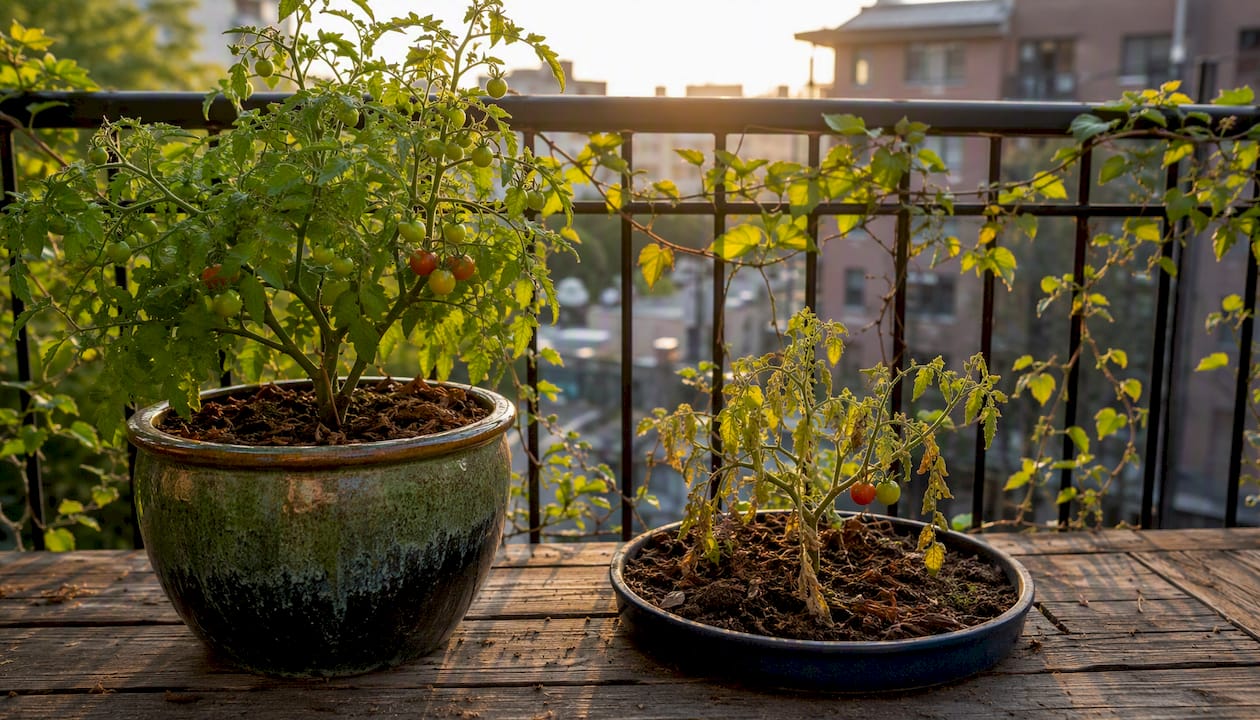
A tomato in a 10-gallon pot looks fine through June. By late July, when heat peaks and the plant is carrying fruit, the root zone is exhausted. Blossom end rot shows up, watering becomes a daily scramble, and yields drop. Move that same variety into a 15-gallon pot and the summer story is completely different. This matches exactly what Purdue Extension recommends: err on the side of a larger container because the buffer it provides for moisture and nutrients pays off most during stress periods, not during ideal conditions.
The university guidance and the real-world outcome align closely. Where they diverge slightly is on the minimum end: extension minimums are true minimums, not targets. Treating a 12" depth recommendation as the goal rather than the floor is one of the most common mistakes in container gardening.
Farmdaddy self-watering planters make depth decisions easier
Getting the right soil depth is half the equation. Keeping that soil consistently moist is the other half, and that is where most gardeners lose ground. Farmdaddy’s self-watering garden planters solve the moisture side of the equation without requiring daily attention, which means the depth you have works harder for you.
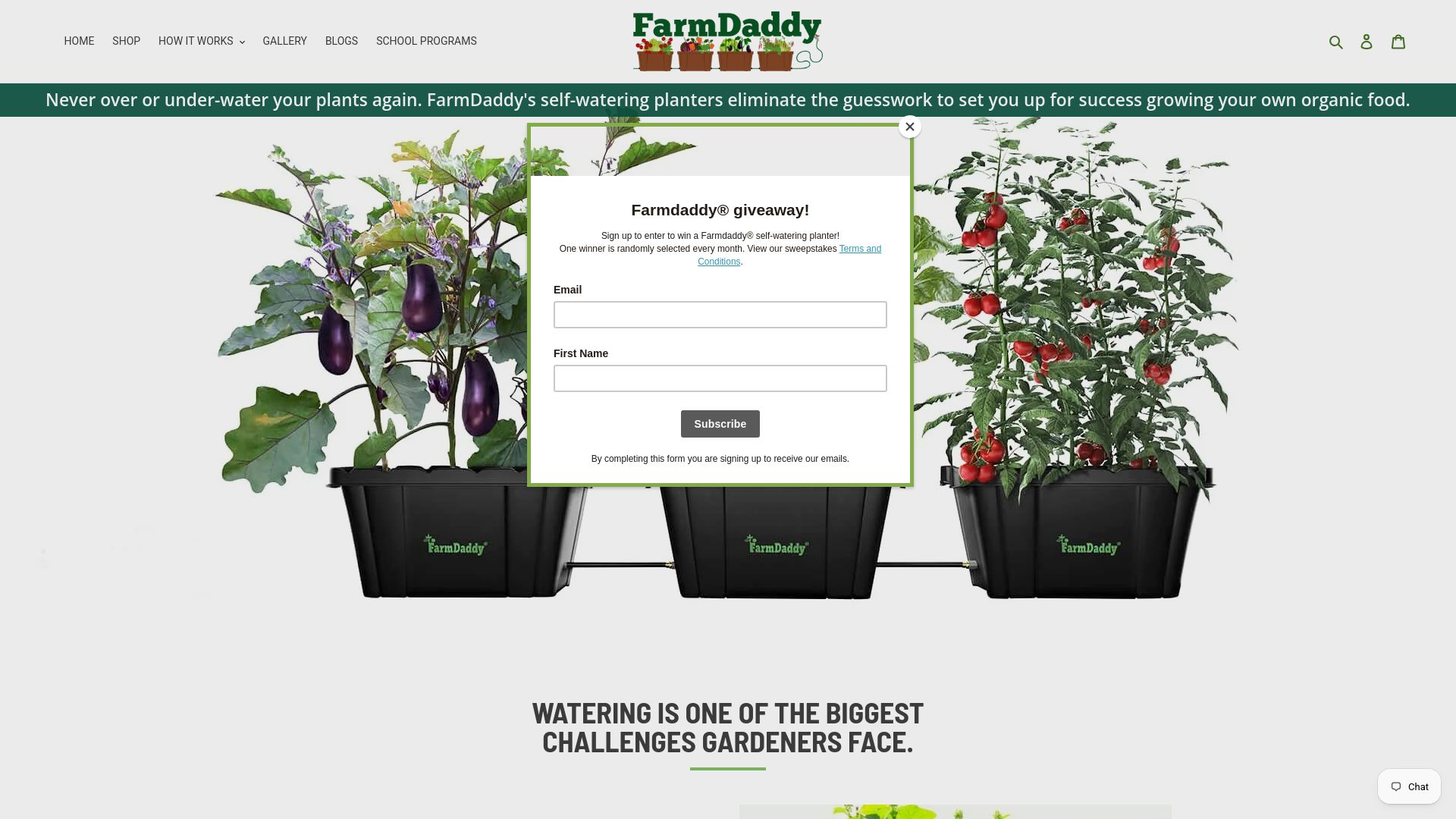
The Farmdaddy Self-Watering Tomato Planter Kit is sized for indeterminate tomatoes and other deep-rooted crops, with enough total depth to leave you 14–16" of usable soil after accounting for the reservoir. For herbs, greens, and medium crops, the Farmdaddy Garden Box handles the full range of shallow and medium vegetables in one compact system. Each container operates independently, so a tomato and a pepper side by side each get exactly the moisture they need, not a shared average.
Choose your planter size by the vegetables you plan to grow, using the chart above as your guide. Then visit Farmdaddy’s product pages to find the right fit.
Sources
These extension and university resources were used to build this guide. Each covers specific crops or techniques in more depth than a single article can.
- Purdue Extension ho-200.pdf
- Types of Containers for Growing Vegetables | University of Maryland Extension
- Growing Vegetables in Containers | UC Master Gardener Program of Contra Costa County
- Care for plants growing in containers | Iowa State University Extension

