
BLOG
Best Automatic Watering System for Busy Gardeners

For container gardeners who want reliable, hands-off plant care, Farmdaddy is the best automatic watering system available today. Its independent per-container reservoirs mean each plant gets exactly the moisture it needs, whether you’re growing tomatoes on a balcony, herbs on a countertop, or running a school garden bed. Travelers, apartment dwellers, and busy families will find it especially freeing. One caveat: self-watering containers work best with moisture-loving plants. Succulents and rosemary need to stay in standard pots.
Table of Contents
- Why self-watering containers are a better choice for you
- Which plants and sites are a good fit for self-watering containers?
- How does a self-watering container actually work?
- What to look for when buying a self-watering container
- Why Farmdaddy is our pick for the best automatic plant watering system
- How to set up and maintain your self-watering container
- What to expect from your container garden in real life
- Common mistakes and how to avoid them
- What real gardeners say about self-watering containers
- Key Takeaways
- A gardener’s honest take on self-watering containers
- Ready to grow with Farmdaddy?
- Useful sources and further reading
Why self-watering containers are a better choice for you
Consistent root-zone moisture is the single biggest advantage a self-watering container delivers. Instead of wet-dry cycles from top-watering, the reservoir keeps the soil evenly moist from below, and your plants respond noticeably.
“Steady moisture delivery from below encourages roots to grow downward toward the water source, creating a stronger anchor and better drought resilience.” — Darryl Cheng, plant care educator at KnowYourPlant
The practical benefits stack up quickly:
- Less daily watering. Reservoirs buffer days to weeks of missed top-watering, making self-watering containers a reliable vacation plant watering solution.
- Reduced blossom end rot. Tomatoes and peppers are especially prone to calcium uptake failures caused by uneven moisture. Steady hydration largely prevents this.
- Lower water waste. Water sits below the soil surface, so evaporation from the top is minimal.
- Better plant survival during travel. Reviews and expert tests confirm that reservoirs can buffer days to weeks of missed top-watering for busy gardeners.
Which plants and sites are a good fit for self-watering containers?
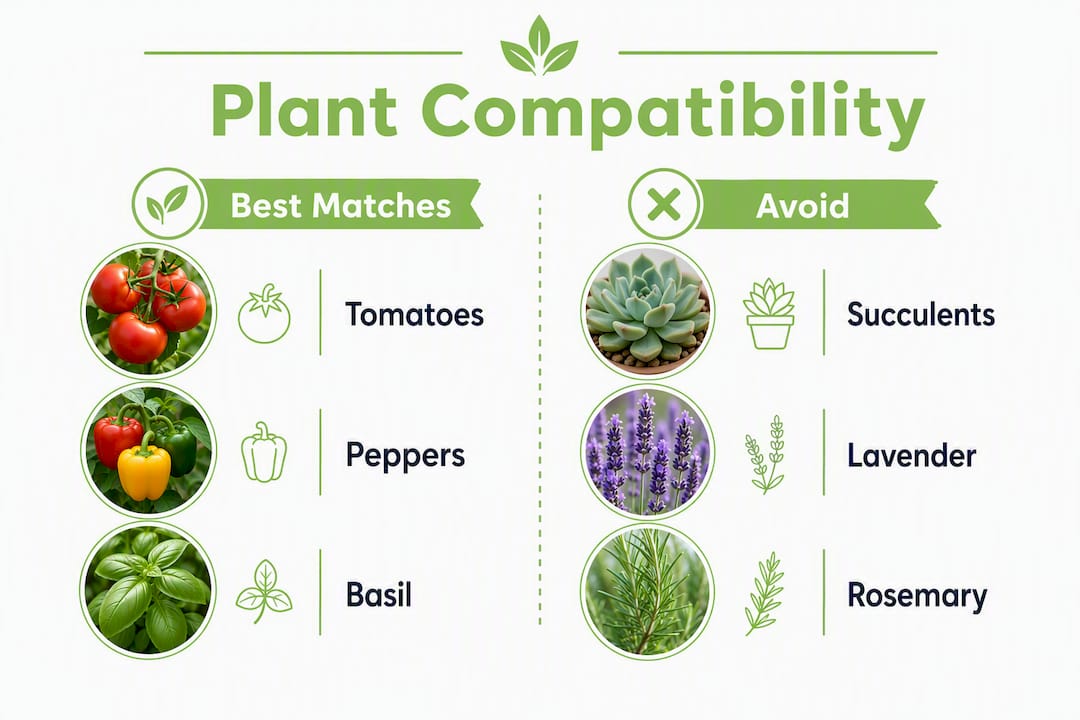
Gardening experts consistently recommend pairing self-watering containers with moisture-demanding species and avoiding them for dry-tolerant plants. Here’s a quick compatibility guide:
| Plant | Compatibility | Notes |
|---|---|---|
| Tomatoes, peppers | Excellent | Thrive with steady moisture; reduced blossom end rot |
| Basil, lettuce, spinach | Excellent | Fast-growing greens love consistent hydration |
| Pothos, peace lily | Good | Moisture-tolerant houseplants do well indoors |
| Strawberries, herbs (mint, parsley) | Good | Moderate moisture needs; check reservoir weekly |
| Succulents, cacti | Poor | Require dry periods; constant moisture causes root rot |
| Rosemary, lavender | Poor | Mediterranean plants need well-drained, drier soil |
Site factors matter too. Indoors, self-watering containers perform consistently year-round. On hot, windy balconies, reservoirs may deplete faster, so check the water indicator more often in summer. If you’re in a USDA hardiness zone that freezes (Zone 6 and below), drain and store containers before the first hard frost to prevent cracking.
For a mixed garden, you can absolutely run self-watering containers alongside standard pots. Put your tomatoes and herbs in the reservoir system, and keep your succulents and rosemary in traditional terracotta.
How does a self-watering container actually work?
A self-watering container works through a simple, passive process: a water reservoir sits at the base, a wicking medium draws moisture upward through capillary action, and the soil column above stays evenly hydrated without any pump or timer.
The key parts are:
- Reservoir: The water storage chamber at the bottom, filled through a dedicated fill port.
- Fill port and water-level indicator: A tube or opening for refilling, plus a visible float or marker so you know when to top up.
- Wicking medium: A soil column or wick material that bridges the reservoir and the root zone.
- Air gap: A small space between the reservoir surface and the soil base, preventing the roots from sitting in standing water.
- Overflow drain: A hole that releases excess water during heavy rain, protecting roots from flooding.
Agricultural engineer Steve Higgins explains that capillary action can lift water roughly 4 inches above the reservoir level, maintaining a continuous connection between the water supply and the root zone without any mechanical parts.
One common concern is that the reservoir will keep roots waterlogged. With the correct soil mix (a light, porous blend) and moisture-compatible plants, the air gap prevents saturation. The system regulates itself.
What to look for when buying a self-watering container
The most important decision is matching reservoir capacity to plant size. A small herb pot with a half-gallon reservoir works fine for basil. A tomato plant in peak summer needs at least 2–4 gallons.
Beyond capacity, here’s what actually separates a great container from a frustrating one:
- Visible water-level indicator. Without one, you’re guessing. Testing guides confirm this is a consistent trait of best-in-class planters.
- Overflow drain hole. Protects against root rot during rain.
- Refill access. A wide fill port makes topping up quick and clean.
- UV-resistant materials. Outdoor containers need to handle sun exposure without cracking or fading.
- Ease of cleaning. Look for a reservoir you can actually reach inside to scrub annually.
- Modular connector options. Systems that link containers together let you scale up without buying entirely new setups.
- Warranty. A manufacturer that stands behind durability is worth the extra few dollars upfront.
On price, entry-level self-watering containers start around $15–$30 for small indoor pots. Mid-range outdoor planters with larger reservoirs and better materials run $40–$80. Full kits with accessories like weed covers and connector hoses sit at the higher end of that range and above, but the reduced water waste and plant loss often offset the cost within a single growing season.
Pro Tip: Use a light, peat-free potting mix or a blend specifically labeled for containers. Dense garden soil compacts over time and blocks wicking. If you’re connecting multiple containers, confirm each one has its own independent reservoir so a thirsty tomato doesn’t rob moisture from a neighboring herb.
Why Farmdaddy is our pick for the best automatic plant watering system
Farmdaddy’s standout feature is its patented independent-reservoir design. Each connected container manages its own water supply, so a heavy-drinking tomato plant won’t deprive a neighboring basil. That’s a real engineering difference from systems that share a single reservoir across multiple pots.
Key features that make Farmdaddy work for busy gardeners and schools:
- Per-container reservoirs that regulate moisture independently for each plant
- Easy-access fill ports and visible indicators so refilling takes seconds
- Durable, outdoor-rated materials built for balconies, patios, and school garden beds
- Connector hoses and weed covers included as part of the accessory ecosystem
- Variants for different setups: compact herb planters for countertops, larger containers for tomatoes and peppers, and raised-bed style garden boxes for schools or families
Farmdaddy users consistently highlight two things: the system works as described during travel, and it’s genuinely easy to set up without prior gardening experience. For a school garden, that last point matters enormously. Teachers and students can get plants growing without daily supervision.
For vegetable growers, the Farmdaddy 2-Planter Self Watering Garden System is a strong starting point. For larger raised-bed setups, the Garden Box handles more plants with the same hands-off approach.
How to set up and maintain your self-watering container
Getting started correctly makes the difference between a thriving plant and a struggling one. Follow these steps:
- Fill the container with a light potting mix. Avoid dense garden soil. Fill to within an inch of the rim.
- Plant your seedling or transplant at the appropriate depth.
- Prime the wick with a top-water soak. This step is non-negotiable: pour water from the top until it drains through, saturating the media completely. Dry potting mix won’t start wicking on its own.
- Fill the reservoir through the fill port until the indicator shows full.
- Check the indicator every few days until you learn your plant’s rhythm.
Refill timetable (approximate):
- Small herb pot (under 1 gallon): every 3–7 days
- Medium or large vegetable containers (2 gallons or more): every 10–14 days in moderate weather, or more frequently during hot spells
Once a year, empty and rinse the reservoir to prevent algae buildup. Before winter in freeze-prone zones, drain completely, dry the reservoir, and store indoors or in a garage.
Troubleshooting: If wicking stops, the soil may have dried out and lost contact with the wick. Re-prime from the top. If you see algae in the reservoir, a diluted white vinegar rinse clears it without harming plants.
What to expect from your container garden in real life
Refill frequency is the metric most new users watch first. A small herb container needs attention every 3–7 days; a larger tomato setup in moderate summer conditions typically runs 10–14 days between refills. In a heat wave, expect to refill more often.
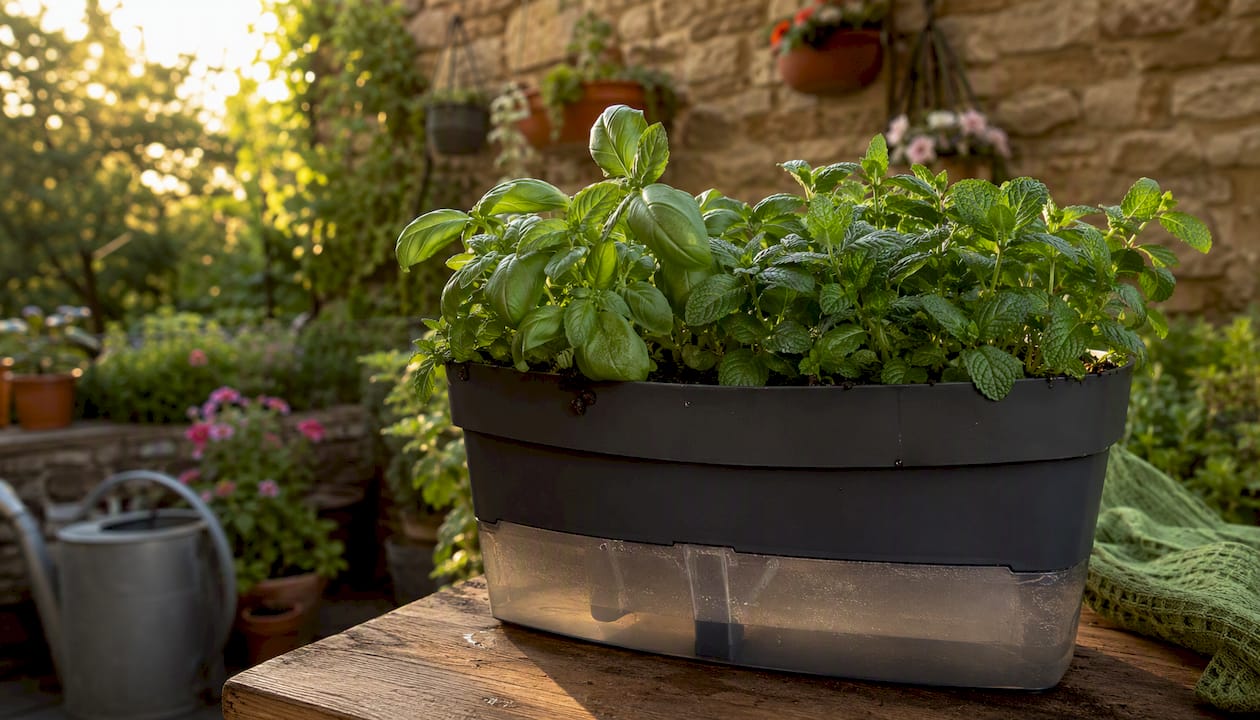
Growth outcomes are genuinely encouraging. Consistent moisture reduces blossom end rot in tomatoes and peppers, and Darryl Cheng’s observation about deeper root development holds up in practice: plants in reservoir systems tend to anchor more firmly and handle brief dry spells better than top-watered counterparts.
The limits are real too. Plants that need dry periods, like succulents or rosemary, will decline in a reservoir system. Very hot, windy microclimates (a south-facing metal balcony in July, for example) can deplete reservoirs faster than expected. And continuous moisture flow can increase nutrient leaching, so use a controlled-release granular fertilizer or light liquid feedings rather than a single heavy dose.
After one full growing season, a well-matched system should show visibly healthier plants, fewer watering emergencies, and noticeably less time spent on daily garden maintenance.
Common mistakes and how to avoid them
The most frequent failure with self-watering containers comes down to two things: wrong plant choice and skipping the initial priming soak. Both are easy to prevent.
Don’t put drought-tolerant plants in a reservoir system. Succulents, cacti, lavender, and rosemary all need dry periods between waterings. Constant moisture from a reservoir leads to root rot, usually within a few weeks. Keep these in standard pots with drainage holes.
Don’t skip the initial top-water soak. A dry potting mix has no capillary connection to the reservoir. If you just fill the reservoir and wait, the wick won’t activate and your plant’s roots will dry out before the system kicks in.
Don’t use dense or compacted soil. Heavy garden soil blocks wicking over time. If your system stops delivering moisture mid-season, the soil mix is often the culprit. Swap it out for a fresh, light container blend.
Quick fixes: if a plant looks overwatered (yellowing lower leaves, soggy soil), let the reservoir run dry before refilling and check that the overflow drain isn’t blocked. To re-prime a dry wick, water from the top until the soil is fully saturated, then refill the reservoir normally.
Before you buy, run through this short checklist: Is your plant moisture-loving? Is the reservoir large enough for your plant’s size? Does the container have an overflow drain and a visible indicator? Can you access the reservoir for cleaning? If yes to all four, you’re ready.
What real gardeners say about self-watering containers
Gardeners who switch to reservoir-based containers most often mention two surprises: how little they actually have to think about watering, and how much better their plants look by midsummer. Tomato growers in particular note fewer cracked fruits and less blossom end rot compared to their previous top-watering routine.
For frequent travelers, the relief is practical. A two-week trip that used to mean returning to dead herbs now ends with plants that are still producing. School garden coordinators report that students stay more engaged when plants aren’t dying between weekends.
The most common complaint in user feedback is about containers with shared reservoirs: one thirsty plant drains the supply and neighboring plants suffer. Farmdaddy’s independent-reservoir design directly addresses this, which is why it consistently earns positive mentions from gardeners running mixed plantings.
Window herb planters are another popular entry point. A compact window herb planter box with individual wicking cells lets you grow basil, parsley, and mint side by side without one plant dominating the water supply.
Key Takeaways
Self-watering containers with independent reservoirs, like those from Farmdaddy, give busy gardeners consistent root-zone moisture, fewer watering emergencies, and plants that genuinely thrive with minimal daily effort.
| Point | Details |
|---|---|
| Best plant matches | Use for tomatoes, peppers, basil, and lettuce; avoid for succulents, rosemary, and lavender. |
| Priming is required | Always top-water soak first; dry soil won’t start wicking and can starve new roots. |
| Refill frequency | Small herb pots: 3–7 days; containers with 2 gallons or more: 10–14 days in moderate weather. |
| Key buying features | Prioritize visible water indicator, overflow drain, UV-resistant materials, and independent reservoirs. |
| Farmdaddy recommendation | The 2-Planter System and Garden Box offer independent per-container reservoirs suited to mixed plantings and school gardens. |
A gardener’s honest take on self-watering containers
The conventional wisdom says self-watering containers are a convenience product, something you buy when you’re too busy to water properly. That framing undersells what they actually do. The real benefit isn’t laziness. It’s consistency, and consistency is what most container gardens lack.
Top-watering is inherently uneven. You water when you remember, in amounts that vary, and the soil swings between too wet and too dry. Self-watering containers remove that variability entirely. The root zone stays at a steady moisture level, and plants respond by growing more confidently.
What people underestimate is how much plant failure in container gardens comes from inconsistent moisture rather than poor soil, wrong light, or bad fertilizer. Fix the moisture, and a surprising number of other problems disappear on their own. Farmdaddy’s independent-reservoir design takes this a step further by ensuring that each plant in a connected system gets its own regulated supply, which is genuinely useful when you’re growing a mix of heavy feeders and lighter plants side by side.
Ready to grow with Farmdaddy?
Farmdaddy gives you a self-watering system where every container manages its own water supply independently, so you’re not choosing between your tomatoes and your herbs. That’s the concrete difference from generic shared-reservoir planters.
For herb growers and beginners, the 2-Planter Self Watering Garden System is the right starting point: easy to set up, easy to refill, and sized for a countertop or small balcony. For families and schools wanting more growing space, the Garden Box scales up without adding complexity. Add weed covers and connector hoses from the accessory range to keep maintenance even lower.
Visit Farmdaddy’s container gardening hub to browse current options, check seasonal promotions, and find the right system for your space.
Useful sources and further reading
- Self-Watering Containers — University of Maryland Extension
- Self-Watering Pots Guide for Plants — KnowYourPlant Blog
- Self-Watering Planters: The Complete Guide — Smart Garden Guru
- AEN157: Capillary Action Explanation — University of Kentucky Extension
- Proven Self-Watering Containers and Container Gardening Tips — Farmdaddy

