
BLOG
The Best Click and Grow Alternatives for U.S. Shoppers

For most U.S. home gardeners, soil-based self-watering planters are the best overall replacement for Click and Grow — they keep maintenance low, skip proprietary pods, and work with any seeds you choose. If you want faster harvests and more control, pump-circulation hydroponic systems are the stronger pick. Here is a quick shortlist to help you decide right now.
- Best for convenience: Soil-based self-watering planters (no pumps, no nutrient mixing, no daily watering)
- Best for yield and speed: Pump-circulation countertop hydroponic systems (faster growth, adjustable lights)
- Best for custom seeds: Grow-your-own-seed systems (use any seed packet, lower recurring costs)
- Best compact option: Microgreen-only units (tiny footprint, fast turnaround, great for small kitchens)
- Farmdaddy pick: Farmdaddy’s self-watering garden box suits travelers, organic growers, and anyone who wants soil-first growing without proprietary pods or daily watering checks
Farmdaddy is the right call when you travel frequently, prefer organic inputs, or simply want a system that waters itself without an app or a pump.
Key Takeaways
For most U.S. home gardeners, the best Click and Grow alternative is a soil-based self-watering planter for low-maintenance growing or a pump-circulation hydroponic system when faster yield and more plant variety are the priority.
| Point | Details |
|---|---|
| Ease-of-use vs. yield | Soil self-watering systems minimize effort; circulating hydroponic systems maximize harvest speed and variety. |
| Pod costs add up | Grow-your-own-seed and soil-based systems cut recurring costs to seeds only, often under $20 per year. |
| App dependency is a real risk | Some smart garden platforms have shut down cloud features, affecting app-connected models and pod subscriptions. |
| Farmdaddy for soil-first growers | Farmdaddy’s patented independent-container watering suits travelers, organic growers, and low-maintenance gardeners. |
| Next step | Compare upfront unit price plus one-year recurring pod or seed costs before buying any system. |
Table of Contents
- How do these Click and Grow alternatives compare at a glance?
- What does each alternative actually offer you?
- How does Click and Grow actually differ from these alternatives?
- How do you choose the right indoor gardening system for your needs?
- Why is Farmdaddy a practical alternative to Click and Grow?
- The systems that actually hold up over time
- Farmdaddy: grow more with less daily effort
- Useful sources and further reading
How do these Click and Grow alternatives compare at a glance?
| Dimension | Soil self-watering planters | Pump-circulation hydroponic | Modular vertical hydroponic | Grow-your-own-seed systems | Microgreen-only units |
|---|---|---|---|---|---|
| System type | Soil, self-watering reservoir | Circulating hydroponic | Circulating hydroponic | Soil or hydroponic | Soil tray or hydroponic mat |
| Capacity / slots | 2–10 containers | 3–9 pods | 30 plant sites | 3–9 pods or cells | 1–2 trays |
| Seed / pod policy | Any seed, no pods | Proprietary or open pods | Proprietary pods | Any seed | Any seed |
| Maintenance cadence | Refill reservoir every 1–2 weeks | Refill water every 1–2 weeks, add nutrients | Refill weekly, add nutrients | Varies by system | Rinse tray every 7–10 days |
| Time to first harvest | several weeks (herbs/greens) | 3–5 weeks | 4–6 weeks | several weeks | 7–14 days |
| Price range (unit) | $60–$200+ | $100–$200 | $695–$900+ | $50–$100 | $30–$80 |
| Recurring costs | Seeds only (~$5–$20/year) | Pods or nutrients ($20–$60/year+) | Pods or nutrients ($30–$80/year+) | Seeds + nutrients ($10–$40/year) | Seeds (~$5–$15/year) |
| Smart features | None required | App/Wi-Fi on some models | App/Wi-Fi, scheduling | Minimal | None |
| Footprint | Countertop to patio | Compact countertop | Tall floor unit | Compact countertop | Very compact |
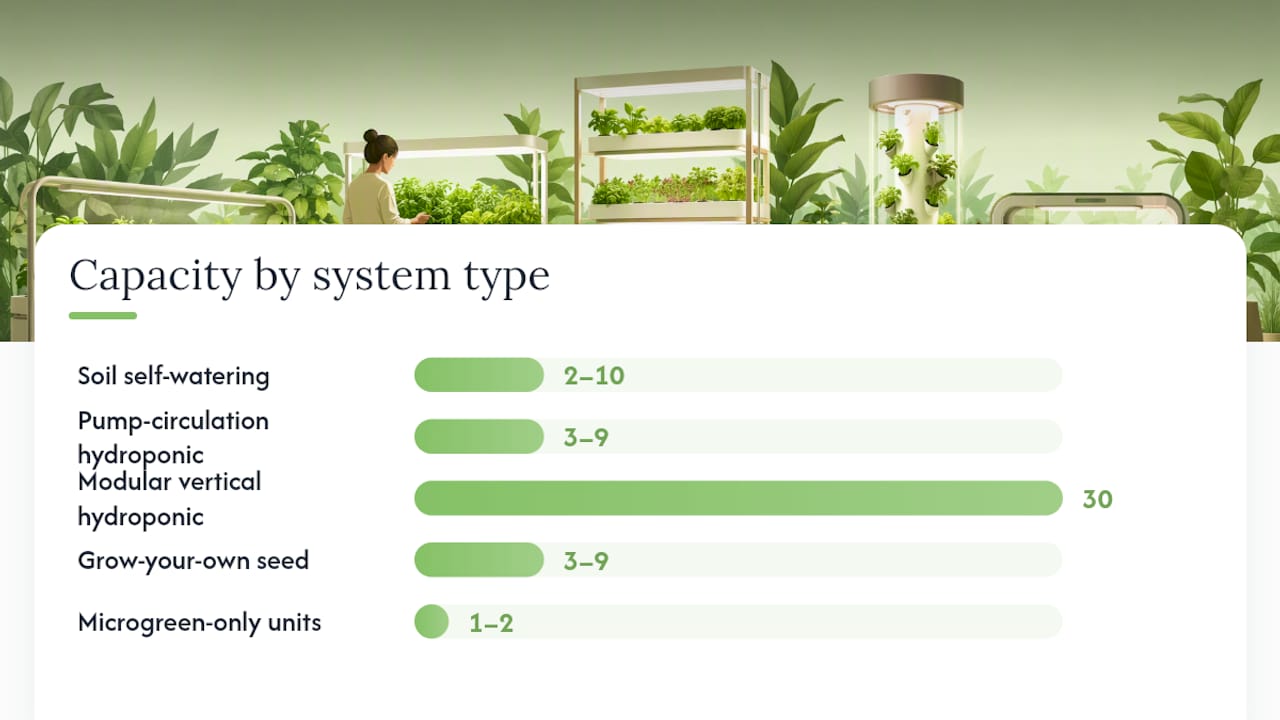
Consumer Reports’ testing identifies the single most important trade-off in this category: ease-of-use versus yield control. Systems that automate watering and lighting tend to simplify the experience but cap what you can grow. Circulating hydroponic systems push yield higher but ask more of you — weekly nutrient top-ups, pump cleaning, and occasional pH checks. If you want to grow tomatoes or larger greens, adjustable light height and nutrient control are the features that unlock that potential. If you want herbs on your counter with almost no effort, a self-watering soil system gets you there with far less fuss.
What does each alternative actually offer you?
Pump-circulation countertop hydroponic systems (AeroGarden)
These are the most popular Click and Grow competitors in the U.S. AeroGarden is the dominant brand here, offering 3-pod to 9-pod countertop units with built-in grow lights and a water pump. Growth is relatively fast, with some herbs harvestable within several weeks. The trade-off is recurring cost: proprietary seed pods run roughly $20–$60 per year depending on how often you replant, and the pump and bowl need periodic cleaning. CNET’s editorial testing found these systems extremely capable for herbs and small greens but noted that larger harvests require the taller models with adjustable lamp arms.
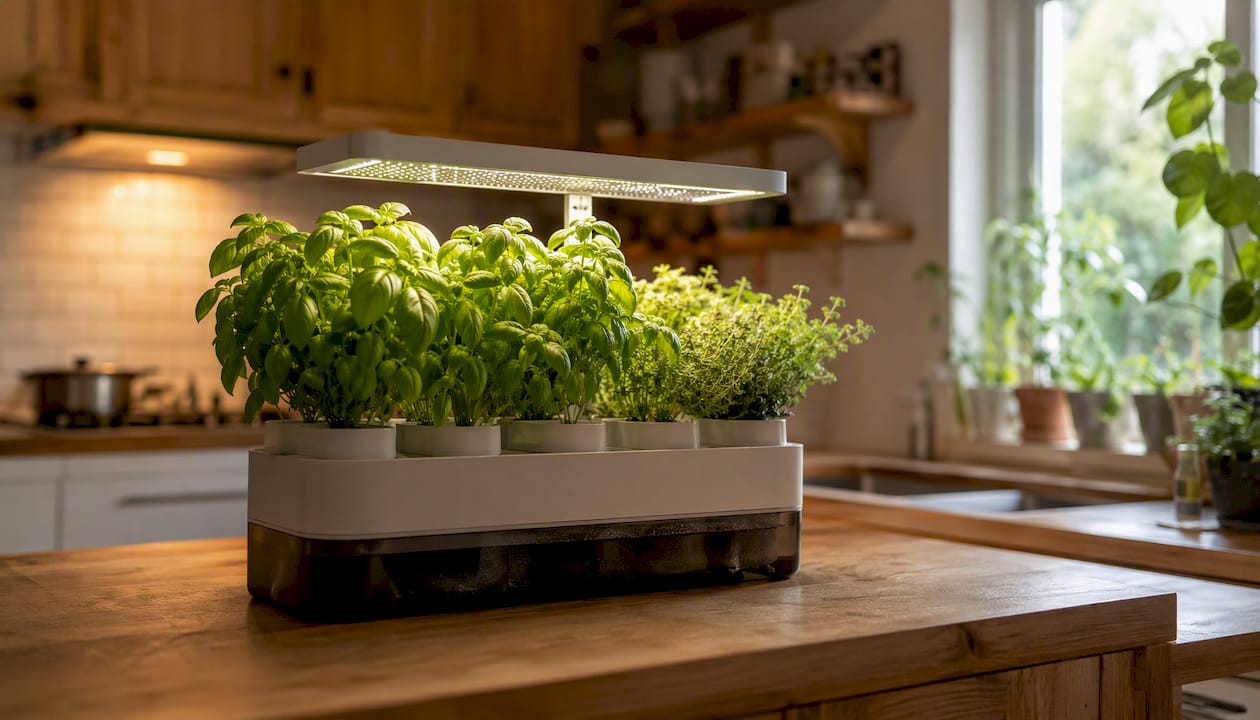
Pros: Fast growth, wide pod variety, easy setup, widely available at U.S. retailers Cons: Proprietary pods lock you into a recurring cost, pump maintenance required, app-dependent features carry a risk (more on that below) Best for: Gardeners who want speed and convenience and don’t mind a pod subscription Typical cost: $100–$200 upfront; $20–$60/year in pods or nutrients
Tall modular vertical hydroponic systems (Gardyn, Rise Gardens)
Gardyn and Rise Gardens sit at the premium end of the indoor gardening systems market. Gardyn’s tower holds 30 plant sites and uses an AI-assisted app; Rise Gardens offers modular shelving that expands from one to three levels. Both use circulating hydroponics and proprietary pods, and both carry a significant upfront investment. Wired’s year-long testing highlights that adjustable lighting and taller grow columns genuinely improve time-to-harvest for leafy greens and fruiting plants. The footprint is substantial — these are floor-standing units, not countertop devices.
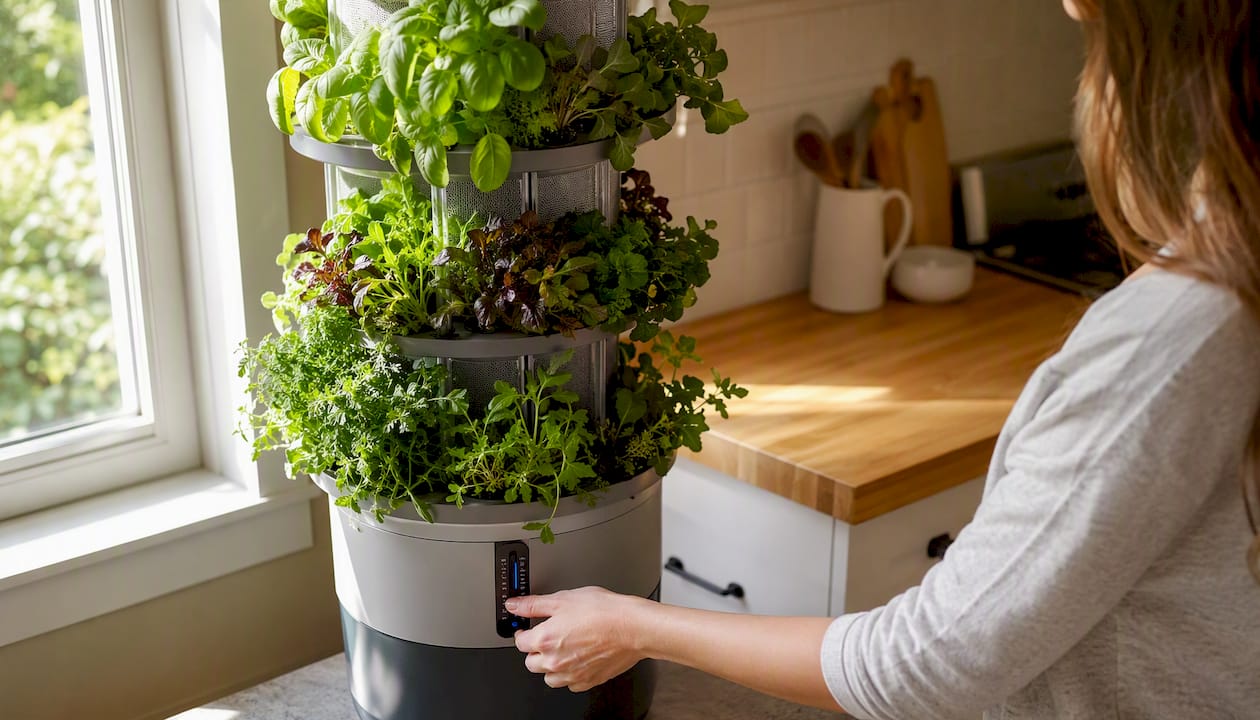
Pros: High capacity, strong yield, good for serious home growers Cons: High upfront cost ($695–$900+), large footprint, proprietary pods, app-dependent Best for: Dedicated home growers with space and budget who want maximum yield Typical cost: $695–$900+ upfront; $30–$80/year in pods
Self-seeded grow-your-own systems (Lettuce Grow, Hamama)
Lettuce Grow’s Farmstand and Hamama’s grow kits let you plant your own seeds rather than buying pre-seeded pods. Serious Eats’ testing notes that grow-your-own-seed systems give real flexibility and lower recurring costs, but they require more setup and sometimes nutrient additions. Hamama focuses on microgreens with seed quilts you swap out every week or two. Lettuce Grow is a larger outdoor-capable hydroponic tower. Both are available to U.S. shoppers online.
Pros: Use any seed, lower recurring costs, no pod lock-in Cons: More setup, some nutrient management needed, Lettuce Grow is large and pricey Best for: Gardeners who want seed flexibility and lower long-term costs Typical cost: $50–$400+ upfront depending on system; seeds and nutrients $10–$40/year
Compact microgreen-only units (Hamama, Modern Sprout)
Modern Sprout makes compact self-watering herb kits and grow kits that sit on a windowsill or countertop. Hamama’s microgreen trays are among the fastest-turnaround options available — most microgreen crops are ready in 7–14 days. These units are affordable and require almost no maintenance beyond rinsing the tray. They are not a replacement for a full herb garden, but they are a great complement to a larger system.
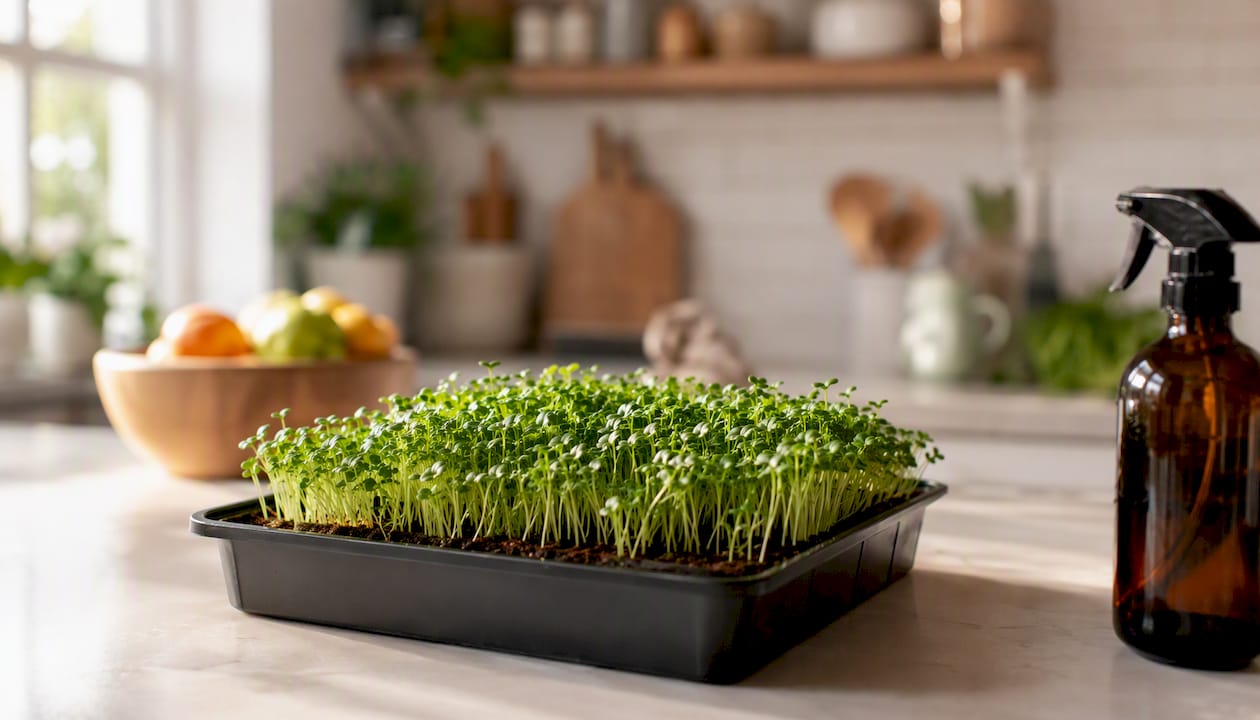
Pros: Very affordable, fast harvest, tiny footprint, minimal effort Cons: Limited to microgreens or small herbs, no grow light included on most models Best for: Small kitchens, beginners, or anyone who wants a quick win Typical cost: $30–$80 upfront; seeds $5–$15/year
Soil-based self-watering planters (Farmdaddy)
Farmdaddy’s self-watering garden containers take a different approach than every hydroponic system on this list. Each container draws water from a shared reservoir independently, so a thirsty tomato plant doesn’t steal moisture from a delicate herb next to it. You fill the reservoir once every one to two weeks and let the system handle the rest. No pump, no app, no proprietary pods. You plant with any seeds or seedlings you choose, and the system works with organic fertilizers if that matters to you.
Pros: No proprietary pods, any seed works, travel-friendly, organic-ready, patented independent watering per container, low recurring costs Cons: No built-in grow light (you supply your own or use a sunny window/patio), soil-based so not as fast as circulating hydroponics for some crops Best for: Travelers, organic growers, families, and anyone who wants low-maintenance soil gardening without daily watering Typical cost: $60–$200+ upfront; seeds only for recurring costs
Pro Tip: If you are switching from a proprietary-pod system like Click and Grow, the two features that matter most when moving to a flexible method are adjustable light height and the ability to control nutrient delivery. These unlock larger leafy greens and fruiting plants indoors. With a soil-based system like Farmdaddy, you get that nutrient control through your choice of fertilizer from day one.
How does Click and Grow actually differ from these alternatives?
Click and Grow uses a capillary-based precision watering approach with pre-seeded proprietary “smart soil” pods. That is meaningfully different from both circulating hydroponic systems and self-watering soil planters, and the differences shape what you can grow and what you spend.
- Watering method: Click and Grow uses capillary action (wicking) rather than a circulating pump. This simplifies setup but limits root aeration compared to circulating hydroponics, which can slow growth on larger plants.
- Pod ecosystem: You are tied to Click and Grow’s pod catalog. Replacement pods are available online, but you cannot simply drop in a seed packet from your local garden center. Grow-your-own systems and soil-based planters have no such restriction.
- Lighting: The Smart Garden 3 and Smart Garden 9 have fixed or minimally adjustable lamp arms. Wired’s testing found that adjustable, higher lamps are a key factor in growing larger plants faster indoors.
- Yield and harvest speed: CNET’s editorial testing found Click and Grow extremely user-friendly but slower for larger harvests compared with taller or circulating systems. Some pod germination inconsistency was also reported in larger plantings.
- Recurring costs: Pre-seeded pod systems cost more over time than grow-your-own-seed or soil-based approaches, as noted in Serious Eats’ independent reviews.
- App dependency: Click and Grow’s basic models are not app-dependent, which is actually a plus. Some competitors rely heavily on cloud features. The Verge reported on smart garden kit shutdowns that affected app-connected models, a real risk for buyers who invest in a pod subscription tied to a specific platform.
For U.S. buyers, all the systems covered here ship domestically. Warranty terms vary: most hydroponic brands offer one-year limited warranties, and some premium brands extend to two years. Check the return policy before buying, especially for units over $200.
How do you choose the right indoor gardening system for your needs?
Work through these questions before you buy.
- How much space do you have? Countertop units (AeroGarden, Click and Grow, Farmdaddy compact planters) fit kitchens and apartments. Vertical towers (Gardyn, Rise Gardens) need floor space and ceiling clearance.
- What do you want to grow? Herbs and microgreens work in almost any system. Tomatoes, peppers, and larger greens need adjustable lights and more root space.
- How often are you home? If you travel or forget to water, a self-watering reservoir system is far more forgiving than a hydroponic pump system that needs regular top-ups.
- What is your recurring-cost tolerance? Proprietary pod systems add up. Grow-your-own-seed and soil-based systems cut that cost significantly over time.
- Do you want organic inputs? Hydroponic nutrients are typically synthetic. Soil-based systems like Farmdaddy’s work naturally with organic fertilizers.
- How much maintenance are you willing to do? Pump systems need cleaning every few weeks. Soil-based self-watering planters need a reservoir refill every one to two weeks and little else.
- Do you want smart features? App connectivity is convenient but carries a long-term risk. The Verge’s reporting on smart garden shutdowns is a useful reminder to check whether a brand’s app and cloud services have a track record of longevity.
Red flags to watch for:
- Systems that only work with the brand’s own pods (no seed flexibility)
- Low germination reports in user reviews
- Weak or unclear warranty terms (less than one year, no return window)
- App-only control with no manual override
- Confusing or time-consuming cleaning processes
Pro Tip: You do not have to pick just one system. A compact microgreen tray for fast weekly harvests pairs well with a Farmdaddy 2-planter self-watering system for herbs and vegetables. You get speed and variety without committing to a single expensive unit.
Why is Farmdaddy a practical alternative to Click and Grow?
The core case for Farmdaddy comes down to three things: no proprietary pods, no pump to maintain, and no daily watering.
Farmdaddy’s patented independent-container design means each planter draws exactly the water it needs from a shared reservoir — so your basil doesn’t compete with your tomatoes, and you don’t need to monitor individual pots. Fill the reservoir, plant your seeds, and come back in a week or two.
That independence matters more than it sounds. In most multi-container systems, plants with different water needs end up either over- or under-watered when they share a single supply. Farmdaddy’s approach solves that without any electronics or app.
The accessory ecosystem (connector hoses, weed covers, compatible organic fertilizers) means you can build out a water-saving garden setup at your own pace, starting with one or two containers and expanding as your confidence grows. For U.S. shoppers, Farmdaddy ships directly to your door, and the product pages document the patented design and available accessories in full detail.
Farmdaddy is a particularly strong fit for:
- Frequent travelers who cannot water daily
- Organic growers who want to choose their own soil and fertilizer
- Families and schools looking for a low-fuss introduction to growing food
- Anyone frustrated by the recurring cost of proprietary pod systems
Pro Tip: Check the best self-watering planters guide on Farmdaddy’s site for a side-by-side look at how soil-based self-watering systems reduce recurring pod costs compared with hydroponic pod ecosystems.
The systems that actually hold up over time
Most indoor garden comparisons focus on the first harvest. What they underplay is what happens in month six, when you are refilling pods, cleaning a pump, or realizing the app your system depends on has been discontinued.
The CB Insights category overview shows just how many funded startups have entered this space, which means there is real product diversity to choose from — but also real churn. Brands come and go, and a pod subscription tied to a platform that loses support becomes an expensive paperweight.
The systems that hold up are the ones that do not depend on a single company’s continued investment in cloud infrastructure. Soil-based self-watering planters sit at one end of that spectrum: no app, no pump, no proprietary inputs. You own the system outright, and it keeps working regardless of what happens to any software subscription.
That is not an argument against hydroponic systems. AeroGarden, Gardyn, and Rise Gardens are real, well-supported products with strong user communities. But it is worth weighing the total cost of ownership — upfront price, annual pod or nutrient spend, and the risk that a platform change disrupts your setup — before committing to an app-dependent ecosystem.
Farmdaddy: grow more with less daily effort
Skip the pod subscriptions and the pump cleaning. Farmdaddy’s self-watering garden containers give you a soil-first growing setup that waters itself, works with any seeds you choose, and keeps going whether you are home every day or away for two weeks.
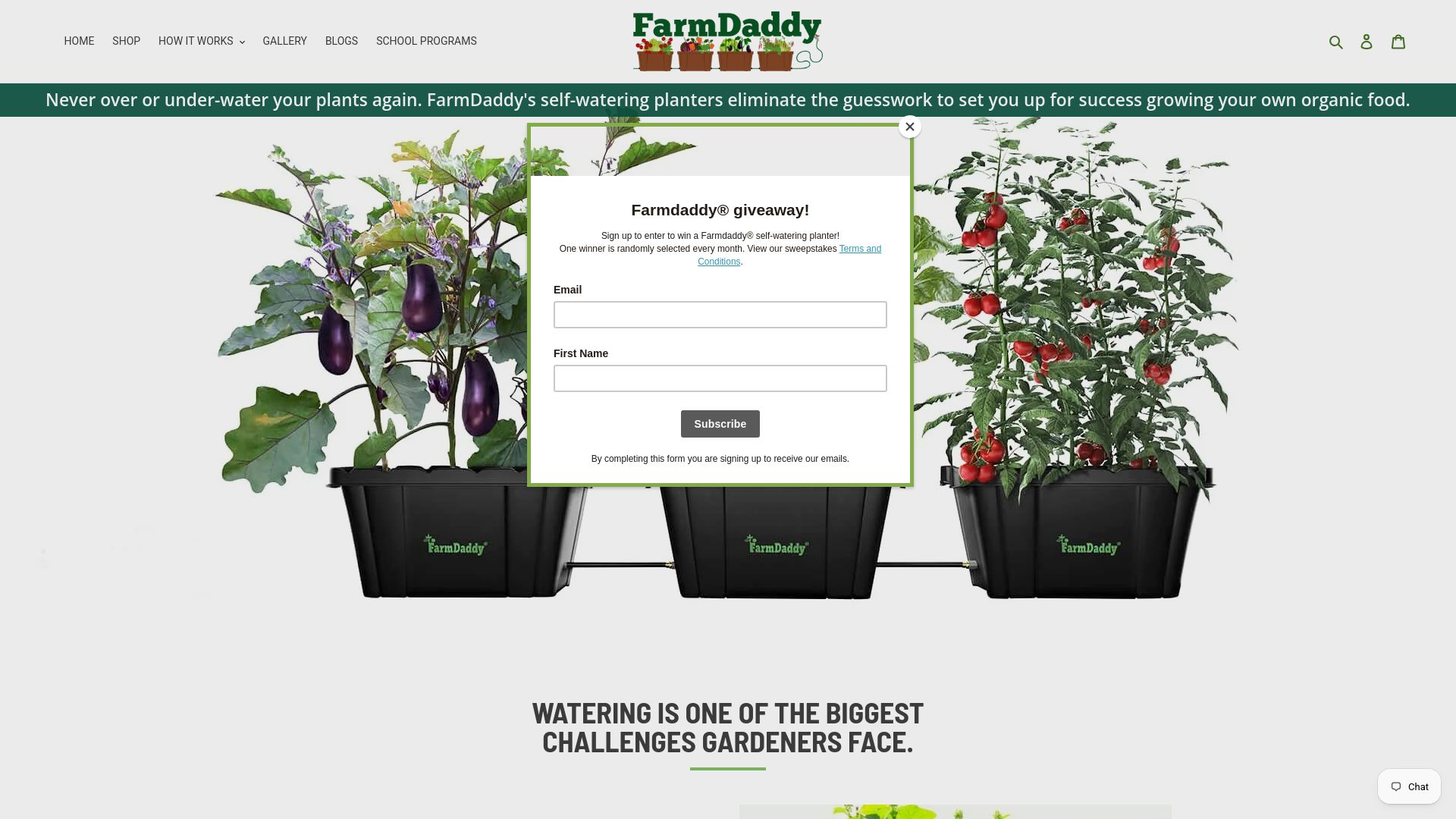
Each container in the Farmdaddy system draws water independently from a shared reservoir, so every plant gets exactly what it needs without you micromanaging. Add your preferred organic fertilizer, plant any seeds or seedlings, and refill the reservoir every week or two. That is the whole routine.
Ready to grow on your terms? Browse the Farmdaddy self-watering garden box and find the setup that fits your space and your schedule.
Useful sources and further reading
- Best Countertop Indoor Gardens - Consumer Reports
- Grow Your Own Herbs and Greens With Our Favorite Indoor Smart Gardens - CNET
- The 5 Best Indoor Herb Gardens of 2026, Tested & Reviewed - Serious Eats
- Best Indoor Garden Systems: I’ve Been Testing All Year (2026) | WIRED
- Top Click & Grow Alternatives, Competitors - CB Insights

